YesTonite - A growth engine without an ad budget, and the first round
How we gave YesTonite a growth engine without an ad budget: a partner program that pays per result, partner outreach that runs itself without hurting the sender's reputation, a feedback loop inside the app, and an investor deck built on honest numbers.
See YesTonite · See the investor deck
Part 6 of the YesTonite series. New here? Start with the main case study: YesTonite - Building a casual dating app for web and Android.
Project snapshot
|
Field |
Detail |
|---|---|
|
Project |
YesTonite: growth engine, feedback loop and investor readiness |
|
Type |
Client project · growth engineering and fundraising support |
|
Client |
City Dev, the Netherlands (operator of YesTonite) |
|
Industry |
Online dating and social discovery (18+) |
|
Built |
2026 |
|
Timeline |
About one week to the live web app · Android in Google Play closed testing from mid-October 2026 |
|
Started |
6 October 2026 |
|
Team |
1 CTO, 1 developer, 1 designer |
|
Delivery |
Built end to end by techlead.fit |
|
Status |
Live in production · partner outreach running daily · seed-stage round open |
|
Under the hood |
Directus 12 custom extension · Node.js · PostgreSQL · IMAP / SMTP · DNS checks · Next.js · Expo · headless Chrome for PDF |
|
Early result |
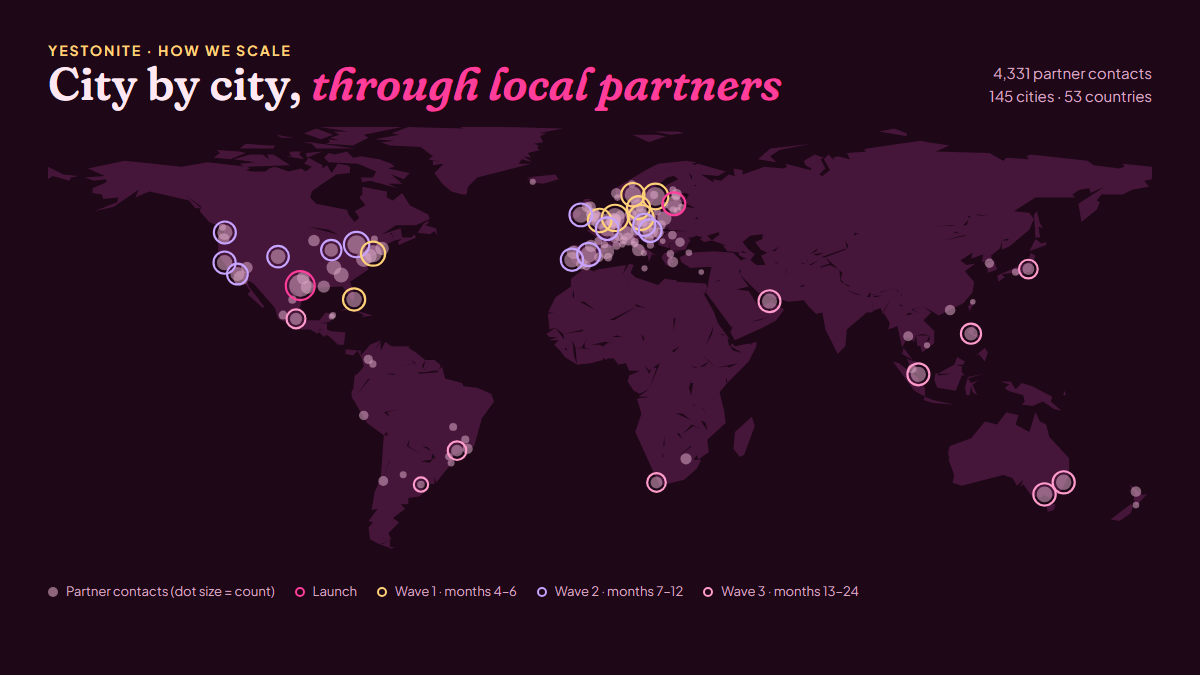
4,300+ partner contacts mapped in 145 cities and 53 countries before launch |
The situation
YesTonite was live: a dating app for meeting people nearby the same evening, on the web and Android, in 44 languages. The next question was the one every consumer app faces after launch: how do the first members in each city find it?
City Dev did not want to buy growth with ads. For dating apps, published benchmarks put the cost of a paying member through ads at $36 in the US and over $100 in Europe. That is more than a paying member brings in at YesTonite's prices.
The challenge
-
Reach the people locals already trust (nightlife creators, event promoters, venues, city guides) in many cities and languages, with a team of three.
-
Do it by e-mail from a brand-new domain without landing in spam or getting the mailbox blocked.
-
Learn quickly from the first members what to improve, without annoying them.
-
Prepare an investor story that holds up when someone checks the numbers.
Decisions before code
Pay for results, not for clicks. Partners earn a fixed amount for every new member who joins through their link and becomes a paying user. That is profitable from the first purchase and needs no ad budget.
Slow and verified beats fast and blocked. Outreach sends a few personal e-mails an hour, never in bulk, and only to addresses that pass checks first.
Everything in the existing backend. Contacts, campaigns, sends, bounces, replies and unsubscribes live in the same Directus database as the product, so the team sees them in Studio.
Honest numbers. The investor model separates published industry benchmarks from YesTonite's own targets, and says so on every slide.
How it works
Partner outreach that runs itself
-
Contacts are added through an API with a bot token, city by city, each with the source where the business e-mail was published.
-
Every address is checked before the first e-mail (syntax and DNS), and the domain is checked again right before every send. Dead or unregistered domains are marked invalid and never mailed.
-
A scheduler sends one e-mail at a time within hourly and daily limits, only during the contact's local daytime, in the contact's language (12 languages), with up to three messages per contact.
-
The mailbox is read every 15 minutes: hard bounces stop the sequence and suppress the address, real replies stop it and go to a person.
-
Every e-mail has a one-click unsubscribe page and the matching e-mail headers.
A feedback loop inside the app
After a member gets their first reply in a chat, the app asks once for a rating. Five stars open the native App Store or Google Play review. One to four stars open a short "what should we improve?" form, with an option to get an e-mail when it is fixed. When the team marks the item as fixed in Studio, the member gets a personal thank-you e-mail automatically. The same flow runs on the website.
An investor deck that is also a web page
The pitch deck is a page on the website, and the PDF is printed from that same page, so they can never disagree. Every number comes from one model file: change an assumption and the charts, the deck and the PDF update together. The model shows the funnel, three scenarios, unit economics and the milestones the company reports against.
The build
-
Outreach: new collections for campaigns, contacts and sends in Directus, API routes for the bot, a scheduler inside the custom extension, IMAP processing for bounces and replies, suppression lists shared with the product e-mails.
-
Verification: syntax and DNS checks, a double-check with public resolvers when a domain's DNS fails, and an optional mailbox-check provider.
-
Feedback: a rating prompt in the Expo app and the Next.js website, a feedback collection with statuses, and an e-mail hook when an item is marked fixed.
-
Investor deck: server-rendered SVG charts, fixed 16:9 slides scaled to any screen, and a script that prints the PDF and the share images with headless Chrome.
-
Blog publishing: a bot user with its own token that can create and update blog posts, but not delete them, so new articles and translations go live from the repository.
Release and validation
Outreach went live with a small daily limit to build the new domain's sending reputation. Bounces were watched from the first day; when a few addresses bounced, the verification step was added before any further sends, and later the check before every send. The rating prompt ships with the next app build. The investor deck went live at yestonite.com/investors together with its PDF.
Outcome
YesTonite has a growth engine that costs nothing until it works: partners are paid per paying member, outreach runs every day within safe limits, and the team only steps in when a real person replies.
Before launch, more than 4,300 potential partners were mapped in 145 cities and 53 countries, in the order of the planned launch waves.
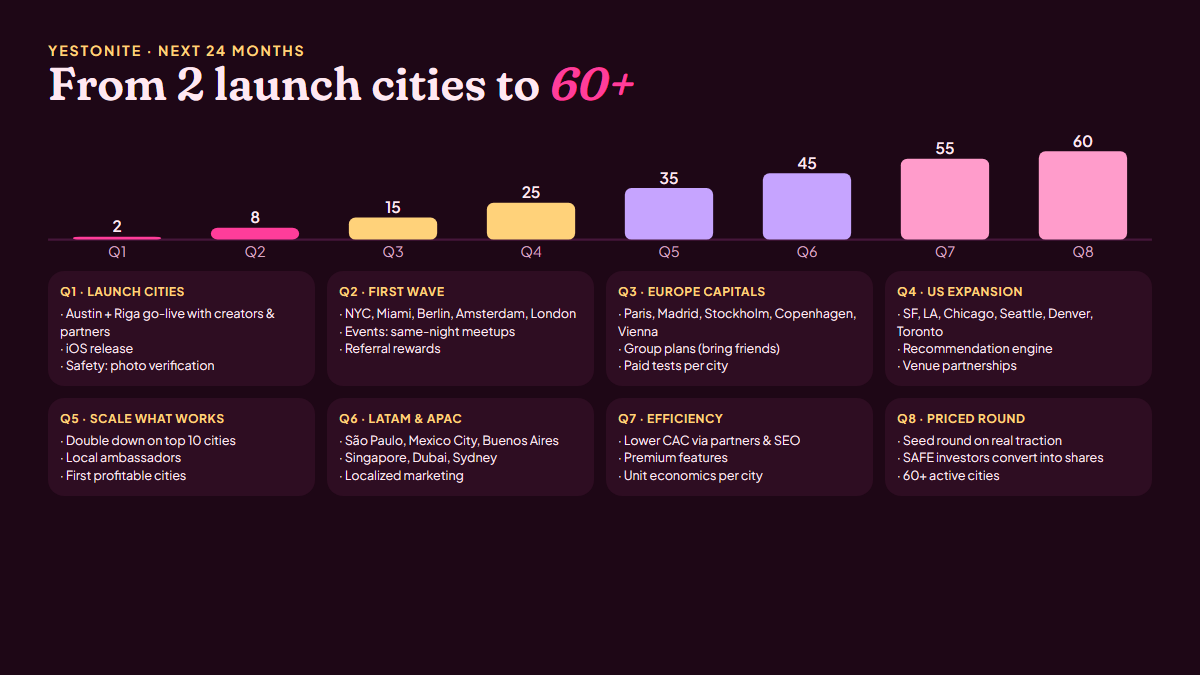
City Dev is now raising a first round for YesTonite to scale from 2 launch cities to 60+ in 24 months. The deck shows the plan, the model and the terms.
What we learned
Growth is part of the product. A partner program, outreach and a feedback loop are features with data models, limits and failure cases, just like chat.
Protect the sender before you need it. A new domain has one chance; verification and slow sending are cheaper than recovering a blocked mailbox.
Investors check the numbers. Separating benchmarks from targets makes the story smaller and much more credible.
Why this is a techlead.fit case study
Most MVPs stop at launch. Here the same team designed how the product finds its first users, how it learns from them, and how it explains itself to investors, all inside the architecture that was already there.
Launch the product.
Build the engine that brings people to it.
Measure honestly, and show the numbers.
The YesTonite series
-
Part 1: YesTonite - Building a casual dating app for web and Android
-
Part 2: Global from day one: 44 languages and regional pricing in 63 countries
-
Part 6: A growth engine without an ad budget, and the first round (this post)
Need growth built into your product?
If your product is live and the next question is how people find it, growth needs the same engineering care as the product itself.
At techlead.fit, we design partner programs, outreach and feedback loops that a small team can run, and help founders prepare an investor story that holds up.
Relevant services: CTO Sprint · MVP Build
The YesTonite round information is not an offer of securities. Investing in a young company is risky; you can lose all the money you invest. Let op! U belegt buiten AFM-toezicht. Geen prospectus vereist voor deze activiteit.